


- What is an Autonomous Enterprise?
- The five levels, in this order
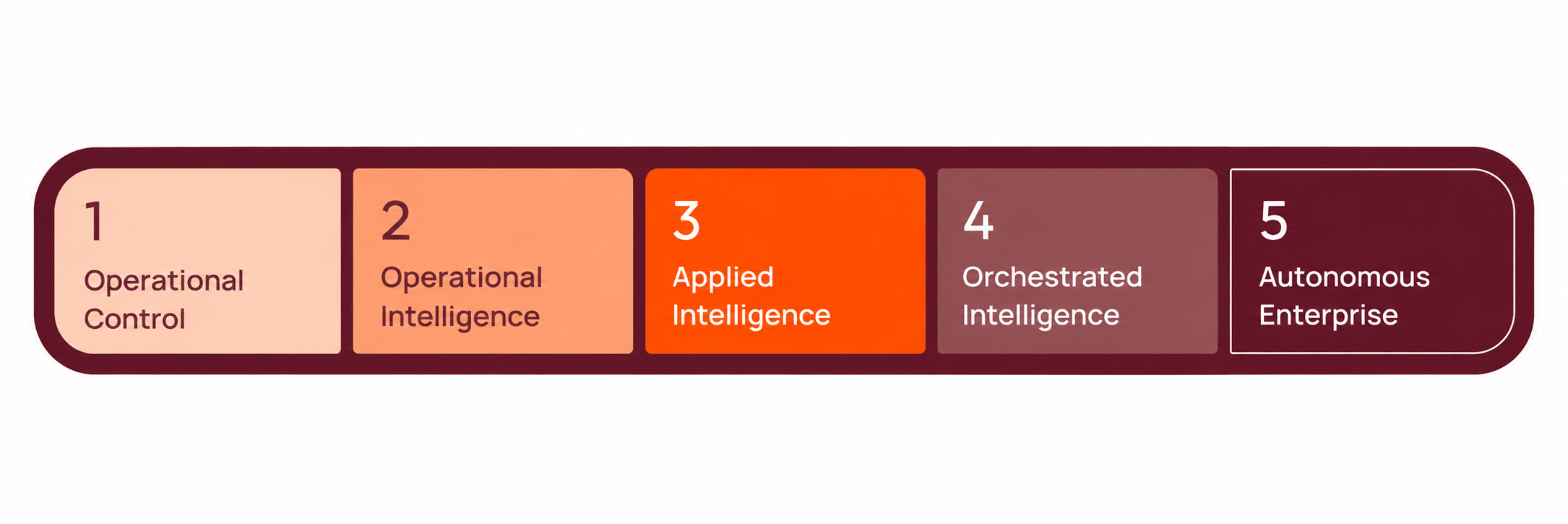
- 1. Operational Control: know how your business runs
- 2. Operational Intelligence: know how your processes perform
- 3. Applied Intelligence: put agents to work on clearly defined tasks
- 4. Orchestrated Intelligence: get agents working together
- 5. Autonomous Enterprise: let parts of your operations run autonomously
- Why you shouldn’t skip a level
- Where does your organization stand?
Building an agent is getting easier. Running your business with them? Not so much. We distinguish five levels on the road to a fully AI-native Autonomous Enterprise. They show where your organization stands today, what you can already delegate to agents and what still needs to happen before you can sit back and let them get on with it.
A chatbot on the website, a few Copilot licenses in sales and a pilot in finance. Plenty of organizations are doing something with AI by now. But the way the business actually operates often hasn’t changed much.
AI is mostly being added to existing ways of working. There’s a lot more potential when you start looking at the processes themselves.
To put it differently: Every process that predates the AI era is basically legacy.
That doesn’t mean every existing process belongs in the bin. It does mean it’s worth taking another look at the work people do, which parts AI agents can take over and how you design your processes around that.
What is an Autonomous Enterprise?
In an Autonomous Enterprise, AI agents independently carry out tasks and parts of business processes. They use data and context to get work done, make autonomous decisions and trigger follow-up actions.
People set the goals and boundaries and stay involved in decisions that require their knowledge or judgement. This can happen across different parts of the organization. An agent might handle customer questions or process incoming orders, for example. When multiple agents work together, they can handle different steps within the same process and pass work on to each other.
What does that get you?
Better service, even outside office hours. Agents can handle customer questions through chat or voice while taking previous interactions into account.
Less manual work. Agents can take over repetitive tasks, process information and move work on to the next step in a process.
More value from your data. AI can identify patterns in your data and flag sales opportunities or anomalies that might otherwise go unnoticed.
More time for work that needs people. Let agents handle repetitive tasks so employees spend less time searching, copying information and doing other routine work.
Step by step, you move towards an organization where agents are part of everyday operations. We distinguish five levels along the way.
The five levels, in this order
The road to an Autonomous Enterprise is a staircase, not an elevator. Each level builds on the one before it. Skip one and you’re building on shaky ground.
1. Operational Control: know how your business runs
Start by mapping out what work is being done, who does it, which systems are involved and which process steps are followed.
In many organizations, some of that knowledge lives in people’s heads, inboxes and separate spreadsheets. That makes automation difficult: you can’t responsibly hand work over to an agent if you don’t have a clear picture of how that work is currently done.
At this level, you document processes, roles and dependencies. This shows you where manual work takes place and which parts could be automated.
2. Operational Intelligence: know how your processes perform
A process description doesn’t tell you where things are going well or where they’re getting stuck. For that, you need insight into what actually happens. Where do delays or bottlenecks occur? Which actions are repeated frequently? Where do exceptions arise? Which data is needed to make a decision?
That also requires usable data. An agent can only work with information it can access and trust. Missing, outdated or inaccessible data limits what you can automate with agents.
At this level, you bring processes and data together and determine where automation makes sense.
3. Applied Intelligence: put agents to work on clearly defined tasks
Now agents can actually start taking work off people’s hands. Begin with a process where it’s clear what the agent needs to do and which systems and data it needs. For example, an agent that processes incoming orders in different formats into your ERP, or one that handles routine customer questions.
The agent now has a defined role within an existing process. You can monitor what it does, where human intervention is still needed and whether the application actually works in practice. That’s how agents become part of everyday operations rather than another isolated experiment.
4. Orchestrated Intelligence: get agents working together
At the next level, agents no longer work only on individual tasks. They pass information and work to one another and collectively carry out multiple steps within a process.
Take an incoming order. One agent can process the data, after which other agents handle follow-up steps around inventory, logistics or invoicing. People step in where checks or judgement are required.
For this to work, agents need to do more than perform their own tasks well. It also needs to be clear which agent is responsible for what, what information can be shared and when a human needs to step in.
Automation now expands from individual tasks to processes that span multiple systems or departments.
5. Autonomous Enterprise: let parts of your operations run autonomously
At the highest level, agents can execute processes, exchange information and trigger actions within predefined boundaries, without an employee having to initiate every step.
People define the goals, limits and exceptions. They step in when something falls outside those boundaries or when human judgement is required. Part of the work therefore shifts from execution to directing, monitoring and handling exceptions.
Why you shouldn’t skip a level
It’s tempting to jump straight to level 3. Building an agent is a lot more fun than mapping out processes. But an agent running on processes nobody understands and data nobody can trust will mainly automate the chaos.
The sequence works like this:
Without control (1), you don’t know which work you can hand over.
Without insight and reliable data (2), an agent has little to work with.
Without proven individual agents (3), orchestration is built on assumptions.
Without agents working together (4), autonomy remains limited to isolated pockets.
That doesn’t mean you need to spend years preparing before you see any results. You can absolutely launch your first agent for one process at level 3 while putting the foundations in place across the rest of the organization. Just make sure you know which level you’re at and what needs to happen next.
Where does your organization stand?
Maybe you already have agents running in production. Maybe you mostly have pilots and separate AI tools. Or perhaps you’re still getting your processes and data ready for the first real applications.
The five levels give you a way to structure that journey: what have you already put in place, what can you responsibly automate today and what do you need for the next step?
Want to know where your organization stands and which step makes sense next? Book a meeting with Edwin below, and we’ll map it out together.